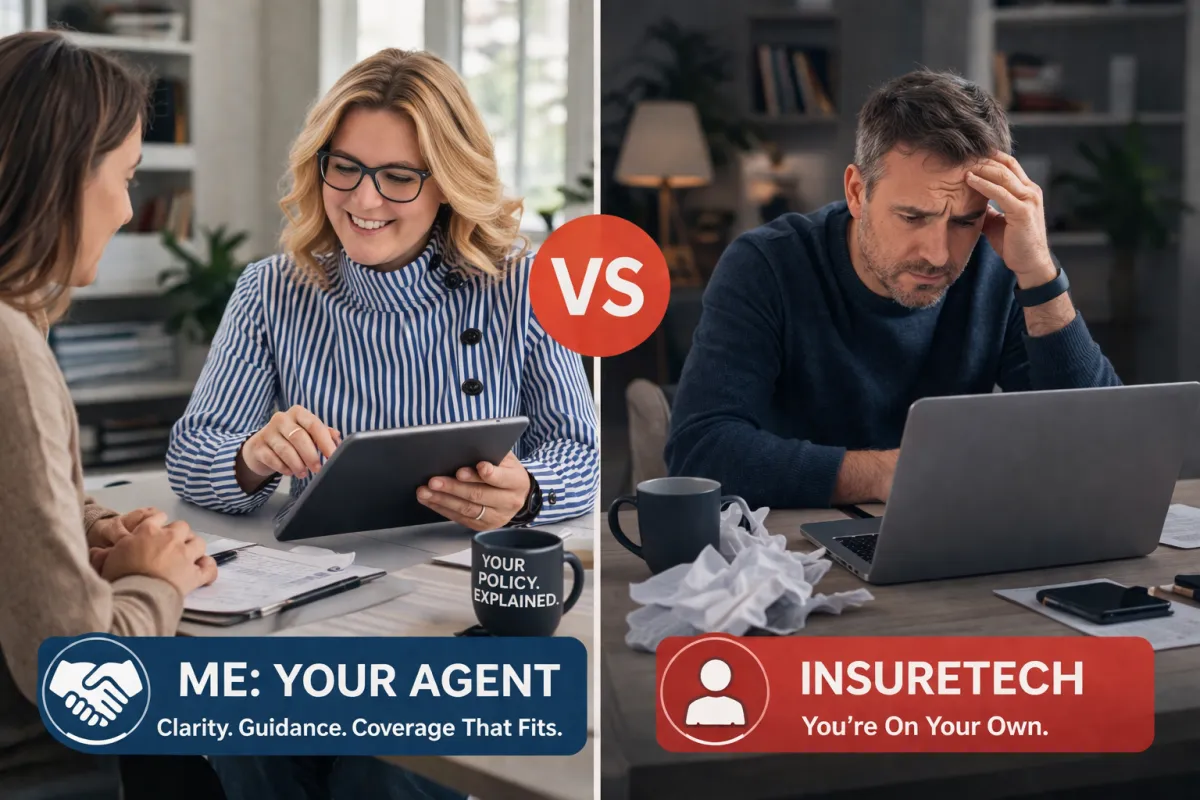
You're Your Own Insurance Expert Now. Are You Ready for That?
We talk a lot about financial literacy. Budgeting apps. Emergency funds. Compound interest. Starting early, investing consistently, building something over time. All important. All worth talking about.
But there is a piece of every financial plan that almost never comes up until it is too late. The piece that is supposed to catch you when everything else fails. The piece that is supposed to make sure a house fire, a car accident, a lawsuit, or a serious injury does not wipe out everything you have spent years building.
Insurance.
Not the app. Not the monthly premium you stopped thinking about two years ago. The actual document. The legal contract. The thing you agreed to and almost certainly have not read.
For a long time, the gap between what people knew about their policy and what was actually in it was bridged by one person: an agent. Someone who sat with you, asked the right questions, walked you through the coverage, and caught the things you would not have known to ask about.
That person is disappearing from the process. Quickly and quietly.
Insurtech platforms and direct-to-consumer insurance channels have changed how people buy coverage in a real way. You can compare policies, adjust limits, and have a binding contract in your inbox in under ten minutes. No appointment. No phone call. No one asking if anything needs clarification.
The convenience is real. The savings can be real too. But here is what those platforms leave out of the process entirely: any indication that the responsibility for understanding what you just bought now sits fully and legally with you.
That shift happened. Nobody announced it. Most people have no idea it occurred.
Financial literacy is not just about saving money. It is about knowing what happens when life goes sideways and whether what you bought actually protects you when it does.
What You Actually Agreed To
When you buy insurance, regardless of how or where, you are entering into a legal contract. Not a subscription. Not a service you can cancel if you are not satisfied. A legally binding document that will govern what happens on one of the potentially worst days of your financial life.
Most people treat it like a subscription. They see the charge come out, they assume the coverage works the way they think it does, and they move on. They think about it again when they need to file a claim.
That is the exact moment when it matters whether they understood what they had.
The denial letter comes. The payout is less than expected. The adjuster mentions a condition the policyholder did not know existed. And the policy they thought they understood turns out to work very differently from what they assumed when they bought it.
This is not the insurance company doing something wrong. The policy said exactly what it would and would not do. The problem is the gap between what was written in the document and what the buyer believed they were getting.
That gap, legally and practically, lands on the policyholder.
A smooth checkout experience is not the same as a policy that works the way you think it does. The exclusions do not disappear because no one explained them. The conditions do not go away because the process was fast.
The Four Legal Characteristics of Every Insurance Policy
An insurance policy is not a typical contract. It has four specific legal characteristics that shape how it works, how courts read it, and what rights and responsibilities you actually have. You do not need to memorize legal terminology. But you do need to know the rules of what you agreed to.
1. It Is a Unilateral Contract
In a unilateral contract, only one party makes a legally enforceable promise. In insurance, that is the insurer. The insurance company promises to pay for covered losses. You, the policyholder, are not legally required to keep paying premiums.
If you stop paying, the policy lapses. You are not in breach the way you would be if you stopped paying a car loan or a mortgage. No collections, no lawsuit for non-payment. The coverage just ends. Understanding this actually matters because it changes how you think about what you owe and what they owe within the contract.
2. It Is a Conditional Contract
The insurer is only required to pay if specific conditions are met. This is the one that catches people off guard at claim time most often. The conditions are not suggestions. They are legal requirements that have to be satisfied before payment is owed.
Typical conditions include the loss being a covered peril, premiums being current, the claim being reported within the required timeframe, and the policyholder cooperating with the investigation. Miss a material condition and the insurer's obligation to pay can go away entirely, even when the loss was real and significant. That is not a loophole. It is the foundational structure of how insurance works.
3. It Is a Contract of Adhesion
A contract of adhesion is written entirely by one party. The insurance company drafted every word: the coverage, the exclusions, the definitions, the conditions. You had no ability to negotiate the language. You accepted it as written or you walked away.
Courts have recognized how one-sided that is. The principle that came out of it is significant: when the language in an insurance policy is unclear or ambiguous, courts typically interpret it in favor of the policyholder, not the insurer. That is one of the most meaningful consumer protections in insurance law, and most people buying policies today have never heard of it.
4. It Is an Aleatory Contract
An aleatory contract involves an intentionally unequal exchange based on something uncertain in the future. In insurance, you might pay $1,200 in premiums over a year and file no claims. Or you might pay $1,200 and receive $400,000 after a major loss. The exchange was never meant to be equal.
A lot of people feel like they wasted money when a year goes by without a claim. That framing misses what was actually purchased. Insurance is not a savings account. It is not a product designed to give you back what you put in. It is a way to transfer financial risk from yourself to the insurer. The unequal exchange is not a flaw in the product. It is the whole point.
The Responsibility That Comes With Buying It Yourself
This is where it gets uncomfortable. Courts hold policyholders to a standard of understanding that would surprise most people, especially now when complex legal documents are being sold through interfaces designed to feel as easy as checking out online. The legal standard has not changed to match the channel.
The duty to read your policy. If you accepted the policy, courts assume you had the chance to read it. The document being long or technical does not change that. "I did not know what it said" does not hold up on its own in a coverage dispute.
The duty to ask questions. If something in your policy is not clear, you are expected to ask before a problem comes up. Not after. Courts do not look kindly on policyholders who assumed coverage existed for something that was not in the policy when they had the opportunity to ask and did not. Staying quiet works against you.
The duty to review for accuracy. You are responsible for checking what is on your policy and fixing mistakes. Wrong address, missing driver, incorrect coverage limit, outdated property value. If those errors are sitting there and you never said anything, they become your problem when you file a claim.
The duty to understand what you are buying. Accepting a policy creates a legal presumption that you understood its material terms. Coverage disputes built on "I did not know there was an exclusion for that" do not go well when the exclusion was clearly written in the document you signed off on.
When you buy through an agent, these duties are still there, but there is someone in the process whose professional responsibility includes making sure you understand what you bought. They ask questions, explain what matters, flag the gaps, and document the conversation. When you buy direct, none of that happens. The duties stay. The person responsible for fulfilling them is just you.
The Gap Nobody Warned You About
Direct-to-consumer platforms and insurtech did not create bad policies. What they created is a large group of confident buyers who may not actually understand what they purchased.
The experience is designed to feel thorough. You compare carriers. You watch the premium adjust as you change deductibles. You pick from labeled coverage options. A confirmation lands in your inbox. The whole thing feels like an informed decision, because in terms of price and process, it often is.
But there is a real difference between completing a smooth transaction and understanding the contract you just entered into. The checkout experience is built to optimize the first one. Nobody in that process is responsible for the second.
The gap is not in the product. It is in the understanding. When a claim gets denied because of something buried in that document, there is no one who failed to explain it to you. That is the trade-off direct buying does not advertise.
The Confidence Trap
Here is something that does not get talked about enough. The confidence that comes from buying something yourself can actually work against you. When you compared quotes, reviewed the summary, and made your own choice, you feel like you know what you bought. That confidence makes you less likely to dig into the details that actually matter at claim time.
The coverage summary and the policy document are not the same thing. The summary tells you what the policy is built to do. The policy document tells you all the ways it will not do that. The exclusions. The conditions. The definitions that apply to words you thought you understood. The sub-limits you did not notice. The cooperation requirements you are on the hook for. The document is what governs when something goes wrong. Not the summary. Not the checkout screen.
What the Missing Conversation Actually Costs
When an agent is part of the process, something happens that no comparison tool can replicate: a real conversation. A good agent asks questions that surface coverage gaps the buyer did not know to look for. They know the homeowner who finished a major renovation needs to update their coverage limit. They know the business owner who added a delivery driver needs commercial auto. They know which exclusion is going to matter for this specific person's situation.
None of that comes out of a dropdown menu. It comes from professional knowledge applied to someone's actual life. And that conversation is increasingly not happening.
Here is what I want to say plainly as an insurance agent: we are genuinely happy to help. That is the job. We are here to help people transfer risk, understand their coverage, and make sure the policy actually fits the life they are living. Think about what the trade-off really is. A few minutes of convenience buying a policy at 1am, or saving a few dollars on the monthly premium. Is that worth giving up professional expertise, a real conversation about your actual situation, and someone in your corner when a claim comes in? That is worth sitting with before the answer gets made for you at the worst possible moment.
What This Looks Like in the Real World
These are not hypothetical situations. They happen across every line of insurance regularly.
Homeowners
A homeowner buys through a direct platform and picks a coverage limit based on their purchase price. Three years later there is a major fire. The adjuster puts the replacement cost well above the policy limit because construction costs went up and the coverage was never updated. The settlement covers part of the loss. The homeowner had never heard of replacement cost inflation, coverage limit updates, or extended replacement cost endorsements because nobody explained any of that when they bought the policy. The policy was accurate. The coverage was not enough. That gap lived in an assumption that nobody caught.
Auto
A college student comes home for the summer. The policyholder figures they will add them at the next renewal and does not update the policy right away. The student gets into an accident. The carrier finds the undisclosed driver and starts looking at whether the misrepresentation affects coverage. The policyholder was not trying to hide anything. They just did not know that adding a household driver required prompt notification, not a renewal update. The policy said so. They had a duty to know that.
Small Business
A small business owner buys general liability through a direct commercial platform and assumes they are covered. A claim comes in from work done at a client's location. There is a job site exclusion in the policy the owner never read. Claim denied. The exclusion was there. The policy was accepted. A licensed commercial agent would almost certainly have spotted that exposure and recommended the right coverage. That conversation did not happen.
None of these are unusual. They are the predictable result of complex contracts being bought without professional guidance and policyholders carrying legal duties they did not know existed.
The Financial Literacy Conversation We Keep Skipping
We have built a whole world of financial education and insurance is almost completely missing from it. We teach people to budget, invest, manage debt, and build wealth over time. All of that matters.
And then we skip the part of the financial plan that is supposed to protect all of that from the things that have nothing to do with market performance. The lawsuit. The fire. The accident. The disability. The things that do not show up in a financial plan because they are not supposed to happen, until they do.
Insurance Is Not a Transaction. It Is a Long-Term Plan.
The financial events that genuinely devastate people are not usually market corrections. They are the catastrophic and unexpected losses that insurance exists to cover. A house fire that wipes out years of equity. A liability judgment that runs past personal assets. A disability that takes away the income that funded everything else. These are not rare. They are statistically certain to happen to some portion of any population, which is why insurance markets exist in the first place.
The question is never whether these things happen. The question is whether you are actually covered when they do. And you cannot answer that by looking at your monthly premium. You can only answer it by understanding your policy.
The most financially damaging events most people face are not market downturns. They are the sudden and catastrophic losses that insurance is built to absorb, if you understood what you bought.
What Financial Literacy Actually Looks Like
A person who is genuinely financially literate understands more than how to save and invest. They understand the full picture of their financial life, including the contracts that are supposed to protect it. They know what their homeowners policy covers and what it does not. They know the conditions they need to meet to keep their coverage valid. They know when their limits need to be updated. They know what their liability exposure looks like.
You do not have to be a lawyer or work in insurance to reach that level. But you do need to know enough to ask the right questions and recognize when a decision you are making has coverage implications you have not thought through. That is not a high bar. It is also almost entirely missing from the financial education most people receive.
The Bottom Line
Direct-to-consumer insurance is not going away. The access and efficiency it creates are real. But buying that way comes with a transfer of responsibility that most people do not fully clock when they click through the process.
You are the expert now. You are responsible for reading the document. Understanding the conditions. Keeping the coverage current. Knowing the exclusions that apply to your situation. And if the policy does not work the way you expected because you did not understand what you bought, there is no one to point at but the person who accepted the contract.
That is not the system failing. That is the system doing exactly what it was designed to do, just without anyone explaining the design to you beforehand.
Insurance is the part of your financial plan that is supposed to catch you when everything else goes wrong. It only does that job if it actually covers what you think it does, and you can only know that by reading and understanding what you bought.
Read your declarations page. Read the exclusions. Understand the conditions. If anything is unclear, talk to someone who can explain it before you need to use it.
The time to understand your coverage is before something goes wrong. Not after.
Frequently Asked Questions
What type of contract is an insurance policy?
An insurance policy is a unilateral contract, a conditional contract, a contract of adhesion, and an aleatory contract. Each one describes a different legal characteristic of how the agreement works and what it requires from each side.
Is it riskier to buy insurance online without an agent?
The policy terms and your legal obligations are the same regardless of how you buy. The difference is whether a professional helps you understand what you are agreeing to, catches coverage gaps, and makes sure the policy fits your situation. Without an agent, all of that falls to you.
Am I legally required to understand my insurance policy?
Yes, in a practical sense. Courts hold policyholders responsible for reading and understanding what they purchased. Accepting a policy creates the legal presumption that you had the chance to read it. Not knowing what it said generally does not hold up in a coverage dispute.
What happens if I stop paying my insurance premiums?
The policy lapses. Because insurance is a unilateral contract, you are not legally required to keep paying. Stopping is not a breach of contract. The coverage just ends.
What does contract of adhesion mean in insurance?
It means the insurance company wrote the entire contract and you could take it or leave it. Because you had no ability to negotiate the language, courts typically resolve any genuine ambiguity in the policy in your favor rather than the insurer's.
What is an aleatory contract?
One where the exchange is intentionally unequal based on an uncertain event. In insurance, you might pay in for years and never collect, or you might pay a small premium and receive a large payout after a loss. The point is risk transfer, not equal exchange.
What duties do I have as a policyholder?
Courts recognize four basic ones: read your policy when you get it, ask questions about anything unclear before a loss happens, review it for accuracy and flag any errors, and meet all the conditions required by the policy including timely reporting and cooperating with investigations.
Why does financial education skip insurance?
Most financial literacy content focuses on building wealth. Insurance is about protecting it. That side of the equation gets underrepresented even though it is the mechanism that is supposed to prevent one bad event from undoing everything you built. That gap matters more now that people are buying without professional guidance.
About the Author
Katie Pullen is a licensed insurance agent and the owner of Katie Pullen Agency: Allstate Insurance, serving Newark, NY and surrounding communities in Wayne County and the Finger Lakes region. She works with individuals, families, and small business owners to make sure they understand not just what they are paying for, but what their coverage actually does and where the gaps might be. Connect with her on LinkedIn: Katie Pullen


